The Challenge of Wall Assemblies in Cold Climates
A wall assembly in a Canadian climate must do several things simultaneously: resist heat transfer from inside to outside, control air movement, manage vapour diffusion, and stay structurally sound through cycles of temperature and moisture change. The interaction of these requirements is more complex in walls than in attics because the assembly is a vertical, multi-layer structure embedded in the building envelope.
The primary insulation challenge in walls is thermal bridging — the direct conduction of heat through framing members that bypass the insulation in the stud cavities. A standard 2×6 wood-framed wall with R-19 fibreglass batts in the cavities has an effective R-value closer to R-14 to R-16 once thermal bridging through studs, top plates, and bottom plates is accounted for.
Standard Wall Insulation Options
Fibreglass Batt Insulation
The most widely used material in Canadian residential construction. Batts are manufactured to fit 2×4 (R-12 to R-14) and 2×6 (R-19 to R-22) stud cavities. Installation requires care to avoid gaps, compressions, or voids — any of these reduce thermal performance significantly. Kraft-faced batts provide a vapour retarder on the warm side of the assembly, though a full 6-mil polyethylene vapour barrier is standard in most Canadian wall assemblies.
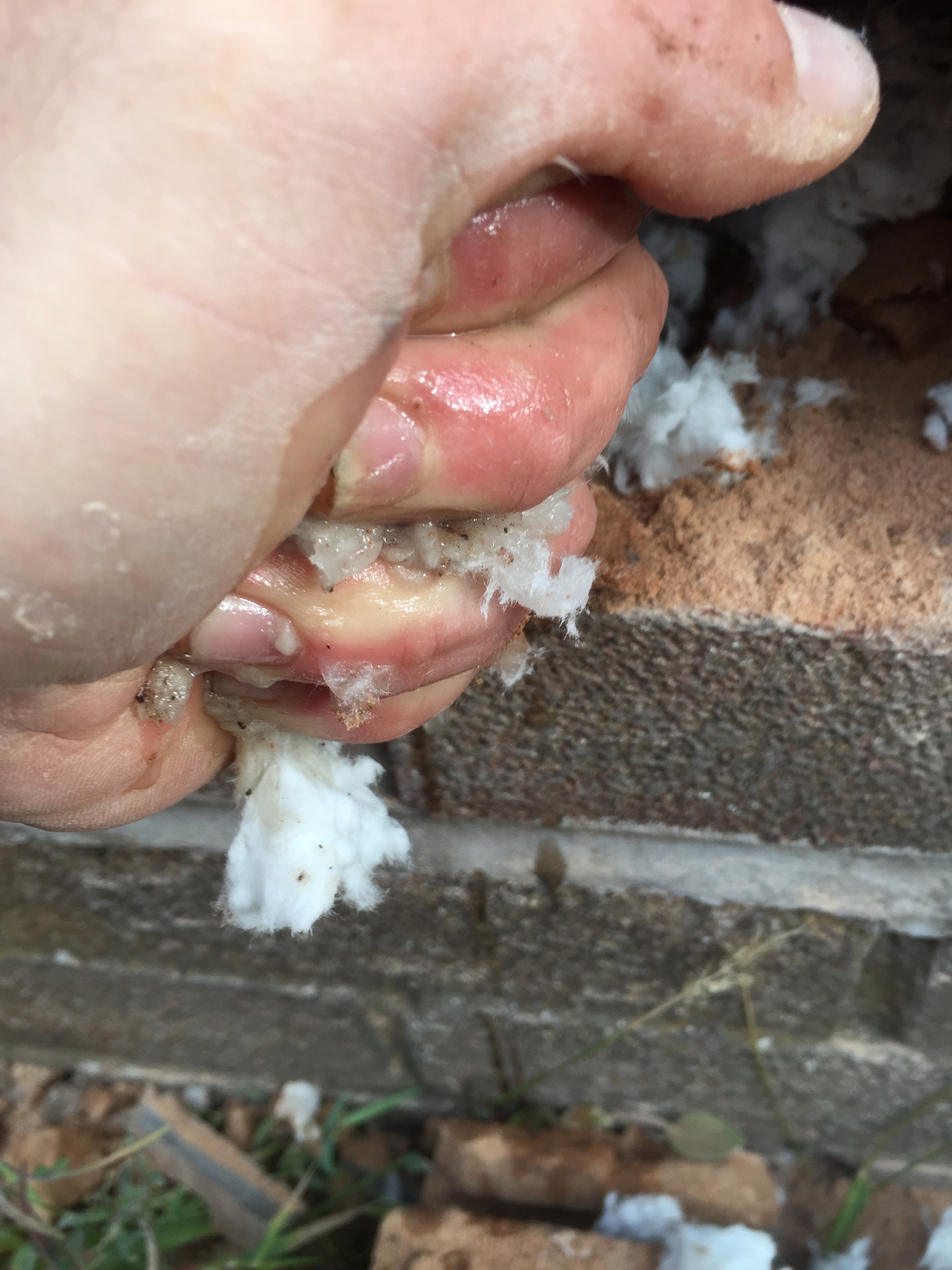
For retrofit applications in existing walls, blown-in fibreglass or dense-pack cellulose can be installed through holes drilled in the exterior cladding or interior finish without removing the wall covering.
Dense-Pack Cellulose
Cellulose blown at high density (approximately 55 kg/m³) into existing wall cavities creates an air-resistant fill that reduces both heat loss and air infiltration. This technique is practical for retrofitting older homes built with minimal or no insulation in the stud cavities. Drill holes are patched after installation. Dense-pack cellulose fills cavities completely, including around blocking, fire stops, and obstructions where batts cannot be cut to fit cleanly.
Rigid Foam Board
Extruded polystyrene (XPS), expanded polystyrene (EPS), and polyisocyanurate (polyiso) boards are used as continuous insulation on the exterior face of the wall framing, eliminating thermal bridging through studs. This approach is increasingly common in new construction and is also used in deep energy retrofits.
| Material | R-Value per Inch | Vapour Permeance | Notes |
|---|---|---|---|
| EPS (Type II) | R-3.6 to R-4.0 | Moderate (1–3 perms at 2") | Lower cost, moisture-tolerant |
| XPS (extruded) | R-5.0 | Low (0.3–1 perm at 2") | Higher R per inch; declining long-term |
| Polyisocyanurate | R-5.5 to R-6.5 | Very low (0.03–0.06 perms) | Best R per inch; avoid below grade |
Adding even 25mm (1 inch) of continuous exterior insulation to a 2×6 framed wall reduces effective R-value losses from thermal bridging and shifts the condensation plane further to the exterior, reducing the risk of interstitial condensation within the wall assembly.
Spray Polyurethane Foam in Walls
Closed-Cell Spray Foam (ccSPF)
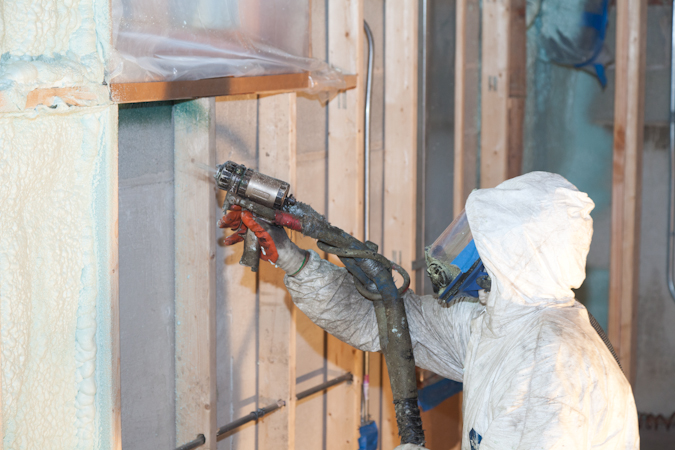
Closed-cell SPF achieves R-6 to R-7 per inch and acts as both an insulator and an air/vapour barrier. In new construction, it is sometimes used to fill the entire stud cavity, providing high R-values in walls that are thinner than conventional framing would allow. In retrofits, a flash-and-batt approach — spraying a thin layer (25–50mm) of ccSPF against the exterior sheathing before filling the remaining cavity with batts — combines the air-sealing and vapour retarder properties of ccSPF with the lower cost of fibreglass or mineral wool.
ccSPF has a blowing agent with a global warming potential (GWP) higher than other insulation materials, which is a consideration in environmental assessments. Some manufacturers have introduced low-GWP formulations to address this.
Open-Cell Spray Foam (ocSPF)
Open-cell SPF achieves approximately R-3.5 per inch and is permeable to vapour. In cold Canadian climates, it requires a separate vapour barrier on the interior side when used in wall cavities, as it does not provide adequate vapour control on its own. It is used more commonly for interior applications, sound attenuation, and in assemblies where inward drying potential is required.
Vapour Barrier Requirements in Canadian Walls
The National Building Code of Canada requires a vapour barrier with a permeance of 60 ng/(Pa·s·m²) or less on the warm side of insulation in walls in climates with more than 5,000 heating degree-days. This requirement applies to most of Canada except parts of coastal British Columbia.
The standard installation is a 6-mil polyethylene sheet installed on the interior face of the studs, continuous from foundation to attic, with all laps taped and penetrations sealed. In advanced wall assemblies using exterior continuous insulation, the vapour barrier may be relocated to the exterior sheathing layer, but this requires a careful analysis of the dew point location within the assembly.
Continuous Insulation for Thermal Bridge-Free Walls
The most thermally efficient approach for new construction in Canadian cold climates is to use continuous exterior insulation that eliminates the thermal bridge path through framing. Approaches include:
- Exterior rigid foam board over the structural sheathing, with cladding attached via furring strips (rainscreen assembly)
- Structural insulated panels (SIPs) that combine framing and insulation in a single factory-built assembly
- Advanced framing (optimum value engineering) that reduces framing density, paired with exterior insulation
- Double-stud walls with a thick cellulose or mineral wool fill in the expanded cavity
Each approach involves trade-offs in cost, labour complexity, and compatibility with existing construction practices. NRCan's EnerGuide for New Homes rating system provides a framework for comparing assembly performance.